
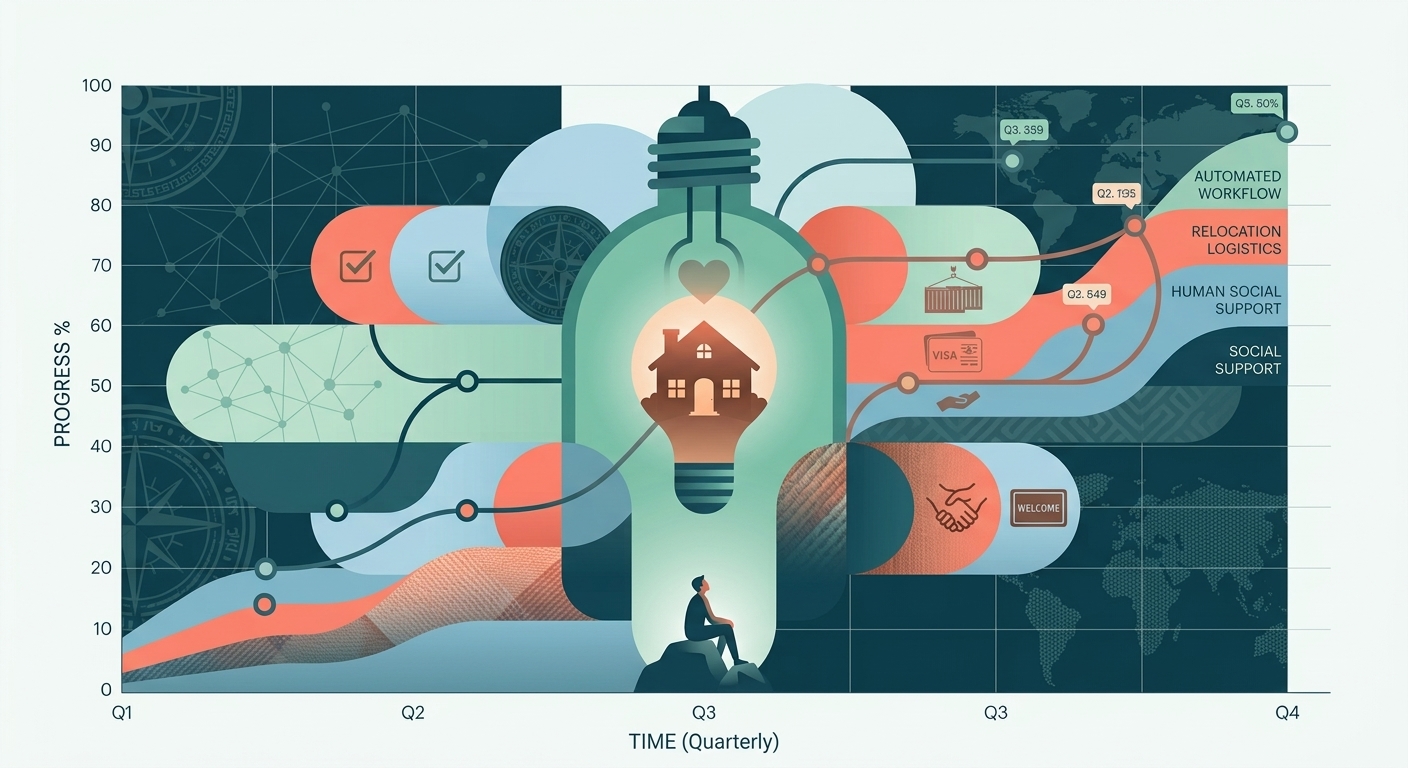
Imagine an executive relocating internationally.
The flights are booked. Immigration documents have cleared seamlessly through an automated workflow. Temporary accommodation is confirmed. An AI-powered portal has organized the checklist, recommended school districts, sent reminders for every deadline, and answered late-night questions about local utility setups.
On the employer's HR dashboard, every indicator is green. The project is marked 100% on schedule.
And yet, three weeks after arriving, that executive is sitting in an unfamiliar apartment wondering if they've made a catastrophic career mistake. Their partner, who left a fulfilling career behind, is feeling isolated and frustrated. Their children are not in school yet; the family is still searching for the right one and trying to get tours booked. The employee is exhausted by endless micro-decisions and cultural friction.
Logistically, the relocation is a triumph. Experientially, it is on the brink of collapse.

This gap is hard to gauge. A system that marks a task complete reports the relocation as finished, so the distance between a completed move and a settled family is rarely measured at all.
The reality of the invisible relocation
In global mobility, the industry spends millions building dashboards that track what is easily visible: visa approvals, lease signings, shipment deliveries, and expense reimbursements.
However, the defining moments of an international move happen off the dashboard.
This is the invisible relocation: the emotional, psychological, and social transition experienced by the employee and their family once the administrative dust settles.

The visible relocation: what the portal sees
- Visa approved
- Lease signed
- Tax code generated
- Shipment delivered
- Expenses reimbursed

The invisible relocation: what the family lives
- Partner career disruption
- Cultural isolation
- School and child adjustment
- Healthcare system confusion
An AI assistant can instantly explain the legal prerequisites for registering with local authorities. But recognizing that an employee's anger over a delayed municipal appointment is actually rooted in deep anxiety about starting over requires human empathy, context, and trust.
What the research says
The technology shift is real. In McKinsey's 2025 State of AI survey, nearly 9 in 10 respondents reported that their organizations regularly use AI, though nearly two-thirds said their organizations had not yet begun scaling it enterprise-wide. Automation in relocation is part of that wider movement, and it is still early.
The human side is equally well documented. A 2019 meta-analysis in Human Resource Management Review, covering 84 studies and 17,718 international assignments, found a positive association between social support and expatriate success. And a 2021 study in the Journal of International Management, involving 173 accompanying spouses and 135 expatriates in China, found that organizational support positively influenced adjustment for the whole family.
That research points to something a completed checklist cannot supply: genuine social support. Software can help people find information and connect with others, but it cannot be the person who cares about them, earns their trust, and takes responsibility for helping them through the transition. That support comes from another human being.
Organizations regularly using AI
Nearly 90%
McKinsey, 2025 State of AI survey
Organizations not yet scaling AI enterprise-wide
Nearly two-thirds
McKinsey, 2025 State of AI survey
Human support and relocation success
84 studies · 17,718 international assignments
Social support was positively associated with expatriate success.
Human Resource Management Review, 2019
173 accompanying spouses · 135 expatriates
Organizational support positively influenced adjustment for the whole family.
Journal of International Management, 2021
The key takeaway
Technology provides efficiency
AI and automation help people find information, track tasks, and make connections.
People provide genuine support
Human relationships build trust, offer reassurance, and help employees and their families adjust.
Human involvement is a relationship, not a delivery method
Human involvement does not mean only being physically present. It can happen on the phone, over WhatsApp, while reviewing a lease, or sitting at a kitchen table. AI processes inputs and generates responses; a human brings lived experience, intuition, accountability, and care. A person listens to tone, reads between the lines, and takes personal responsibility for that employee and family. The channel may be digital. The relationship is human.
A tale of two assignees: the case for context
Consider two employees relocating to Mexico City under the exact same corporate policy.

Assignee A: single professional
- Focus: high-speed setup, autonomy, digital self-service
- Human relationship: trusted check-ins that respect independence and notice isolation

Assignee B: dual-career senior lead with family
- Focus: spouse career transition, school integration, complex medical setup
- Human relationship: ongoing care, family advocacy and personal accountability
Assignee A is a single, early-career software engineer. They may prefer maximum autonomy, immediate digital answers at 11:00 PM, and fewer phone calls. That preference is not evidence that they need no human support. Single assignees can experience acute isolation, cultural burnout, and distress they never enter into a portal. A move can look successful on screen while the person quietly struggles, sometimes until they decide to leave.
Assignee B is a mid-career director moving with a spouse who suspended their own professional practice, and two teenage children. Alongside many of the same administrative tasks, this household faces overlapping career, school, and family transitions. Their needs may be more visible, but Assignee A's quieter struggles are no less human.
Assignees A and B may use tools differently, but neither can be sustained by software alone. A portal-only program can overlook both the family's visible strain and the single employee's silent distress. Each needs a trusted person who checks in, recognizes what is not being said, and follows through.
The goal is not to eliminate self-service technology. It is to use automation for tasks while keeping a human relationship at the center of every assignment, not only those that appear complex on paper.
What automation gets right (and why it matters)
A modern global mobility strategy cannot be built on an anti-technology stance. Artificial intelligence offers genuine, transformative advantages:
- Eliminating administrative friction: AI platforms excel at tracking deadlines, cross-referencing visa requirements, automating tax code registrations, and predicting document delays before they happen.
- 24/7 information access: assignees no longer need to wait for business hours in a foreign time zone to learn basic neighborhood demographics or transport options.
- Operational visibility: mobility managers gain real-time oversight of supplier delivery speeds, budget compliance, and milestone tracking.
When routine coordination is automated, human relocation coaches are liberated from playing administrative telephone. They can step out of the role of logistics coordinator and step into the role of trusted strategic advisor.
Coordinate
Technology organizes tasks, information and deadlines.
Notice
A person hears the hesitation behind an ordinary question.
Be there
Human judgment turns that understanding into support, in the moment.
The evolution of the destination services provider
Up until now, an enormous share of a relocation program's time has gone to meeting timelines, uploading and monitoring documents, updating stakeholders on the move, and producing administrative reporting for the RMC. Necessary work, but work done about the transferee rather than with them.
This is where AI earns its place. If software can take over the endless administrative tracking and reporting, that time goes back where it belongs: to actual time with the client. Whether that happens on a call, over email, by text, or in person is not the point. The point is that the hours finally serve the person relocating, not the paperwork around them.

Where the time goes today
- Chasing timelines, deadlines and milestone checklists
- Uploading, monitoring and chasing documents
- Status updates and administrative reporting for the RMC
- The transferee experiences the program mostly as a portal

Where the time goes with AI
- AI handles task tracking, document monitoring and reporting
- The hours saved return to the transferee: calls, texts, emails, time together
- The consultant's attention shifts from the checklist to the person
- Support reaches the employee and family in the moments that matter
Industry research points in the same direction. KPMG's 2023 Global Assignment Policies and Practices survey emphasizes technology, cost control, employee experience, and the increasingly strategic role of mobility functions. Mercer's 2026 Long-Term Assignment Policies and Practices report, drawing on more than 350 participating organizations, examines how relocation assistance, benefits and assignment policies continue to evolve.
A skilled destination consultant doesn't just hand over a municipal application; they evaluate household dynamics, spot early signs of cultural isolation, guide dual-career spouses toward local professional networks, and provide grounded reassurance during high-stress transitions.
Measuring what matters: redefining mobility KPIs
Measuring only what is easy to automate risks designing mobility programs built around administrative completion rather than human success.
To bridge this gap, forward-thinking enterprise mobility teams are expanding their key performance indicators:
| Traditional operational KPIs | Modern human-centric metrics |
|---|---|
| Days to secure permanent lease | Employee and family confidence at Day 90 |
| Visa processing turnaround time | Accompanying partner integration and satisfaction |
| Budget adherence per move | 12-to-24-month post-move talent retention |
| Vendor SLA compliance rate | Employee performance and role ramp-up speed |

The strategic balance: knowing when a human is needed
The future of global mobility may not be a choice between technology and human connection. It may depend on knowing when we need each.
That distinction is not simply about which tasks AI can complete. No matter how efficient it becomes, AI is not human. It can recognize patterns and respond to what it is told, but that is not the same as intuitively sensing when someone needs another person, or understanding how to support them in the reality of that moment.
A pause on the phone. An anxious spouse who writes on WhatsApp that everything is fine. A question about a lease that is really a request for reassurance. These moments do not always announce themselves as problems. A trusted human can listen, read between the lines, ask a different question, change the plan, and follow through. The difference is not being in the same room. It is a person who cares, exercises judgment, and takes responsibility for what happens next.
Efficiency can complete the move. It cannot replace the human who notices where the person making it needs support.
This piece pairs with what a destination service consultant does, including the section on where AI helps and where it cannot.
Planning an international move?
Holly works at the human end of relocation: the home search, the schools, the first weeks, and the questions no portal thinks to ask. Share a few details about your move to request a plan and a quote.
Work With HollyGet a Quote
Get a quote for your move
Tell Holly about your move and she'll put together a quote.
Read next
- Moving to Phoenix: Your First 30 Days
A practical guide to moving to Phoenix, Arizona, from another state or another country: choosing an area, temporary housing, renting without U.S. credit, schools, driver's licenses, utilities and settling in.
- Making the Most of a Relocation Lump Sum
A practical guide for anyone moving on a relocation lump sum: the tax question to ask HR, where budgets fall short, a worked $12,000 example and a calculator to plan your own.
- Renting in Arizona: Know Your Rights
A practical overview of Arizona renter rights under the Residential Landlord and Tenant Act: security deposits, repairs and essential services, AC failures, landlord access and eviction notices.
Sources
- McKinsey & Company, The State of AI (2025): nearly 9 in 10 respondents report regular organizational AI use; most have not yet scaled it enterprise-wide
- Van der Laken et al., Human Resource Management Review (2019): meta-analysis of 84 studies and 17,718 international assignments on social support and expatriate success
- Shah et al., Journal of International Management (2021): organizational support and family adjustment among 173 accompanying spouses and 135 expatriates in China
- KPMG, Global Assignment Policies and Practices (2023): technology, cost control, employee experience and the strategic role of mobility
- Mercer, Long-Term Assignment Policies and Practices (2026): relocation assistance, benefits and assignment policies across 350+ organizations